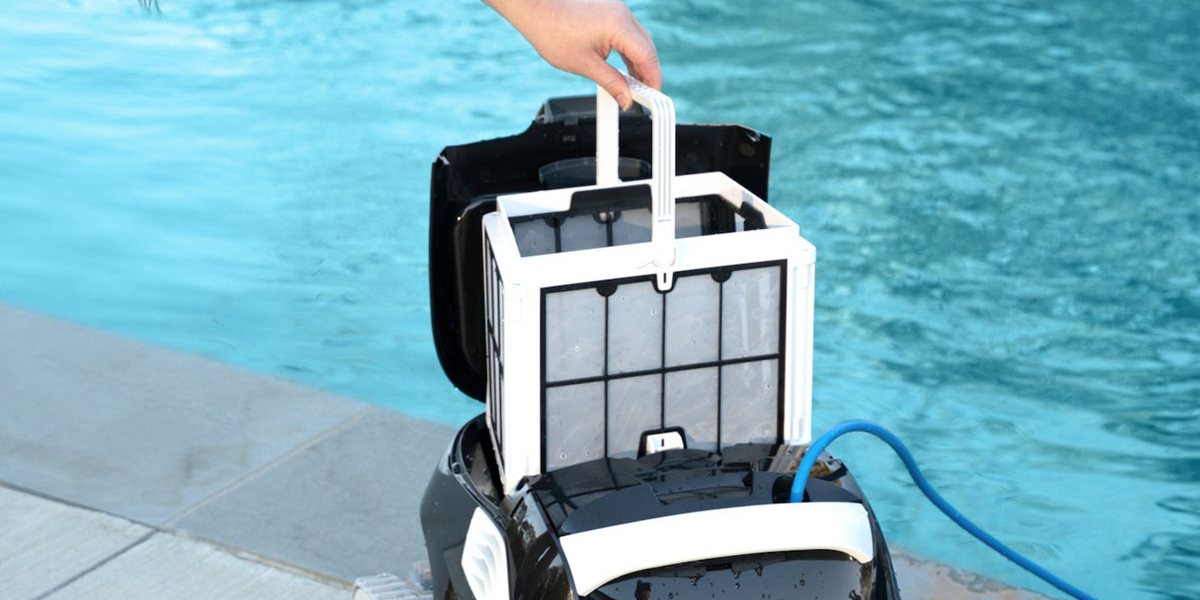
Unlike pool brushes, automatic cleaners can reach every area of your pool and collect small leaves, pine needles and even GUMBALLS. They can be a huge time saver.
If you have a robot that seems to be stuck in one place, check the hose for air leaks between joining points and tears or blockages. Also make sure the hose is the correct length for your pool size.
1. Hose Leak
As with any vacuum, the cleaner is reliant on suction to do its job. When there's a leak in the hose or one of its connections, the cleaner will lose suction and not be able to move around the pool and climb your walls as it should.
The first thing to check is that your hose isn't too long. Measure it from the weir or dedicated hose line to the farthest point in the pool and add 1 meter, if necessary. Check that the feed hose is floating and not waterlogged (old style floats can easily become waterlogged).
If it's too short or if it's leaking at any of its connection points, you need to replace it. You can use duct tape as a temporary fix, but it won't last. Lift the hose out of the water and search each joint for air escapes (make sure the cleaner is not running during this step!). If the hose swivels are leaking you need to replace them.
2. Loose Connections
Robotic cleaners operate independently of the pump and filter system and do not require hose connections. However, they still rely on low-voltage electricity run through a ground fault interrupter circuit to operate.
If your robotic cleaner is struggling to power around your pool or getting stuck on a specific obstacle, there could be a mechanical problem that requires attention. Check the motor and wheels for debris and ensure that all the gears are moving properly.
If your suction side or pressure side cleaner isn’t working, it could be due to a clogged filter, full skimmer basket, or water loss in the hose connection. If the hose is too long, measure the distance from the wall port to the farthest point of the pool and cut it if necessary. Also, make sure hose floats and swivels are not waterlogged or stiff. The sun can help soften them and keep them pliable enough to move freely when the cleaner moves.
3. Debris in the Gears
If your cleaner is having trouble climbing walls or moving around the pool, the gears may be clogged with debris. This can also prevent the cleaner from getting the right amount of pressure, causing it to move too slow or not at all. Check the inline strainer at the wall and hose for kinks or holes that could be reducing the flow of water to the cleaner, and try rotating one wheel. All the other wheels should turn at the same time, and the motor should be running properly to generate this power.
Robot cleaners can also get stuck behind ladders and handrails if the hose is too long or too high. You can solve this by adjusting the hose length or by installing a ladder guard kit. You can also make sure the hose floats are not clogged with debris, and that hose swivels are able to rotate freely. Ensure the cleaner’s canister is not full of debris, and that it gets emptied regularly to keep its performance optimal.
4. Water in the Leaf Bag
When the cleaner is in motion it will suck up the suspended debris particles which are then stored on its own internal filter bag. It may also scrub the surface of your pool floor and walls with brushes located on its body.
Robotic cleaners have brushes which spin with the movement of the cleaner, allowing them to scrub your pool surface and clean it at the same time. They are also stand alone and don’t use suction or pressure from your main pump, so they require less maintenance/tune up than suction or pressure cleaners.
Because of this, they tend to have longer manufacturer warranties than suction or pressure cleaners. However, they still have to be removed from the pool for shocking and periodic rinses of chemical water. Leaving them in the pool 24/7 exposes them to the corrosive chemical water which can cause parts of the cleaner to break down. To prevent this from happening, it’s recommended to drain the cleaner’s filter bag and occasionally rinse off the cleaner to remove any accumulated chemicals.